 MyKrugerHoliday
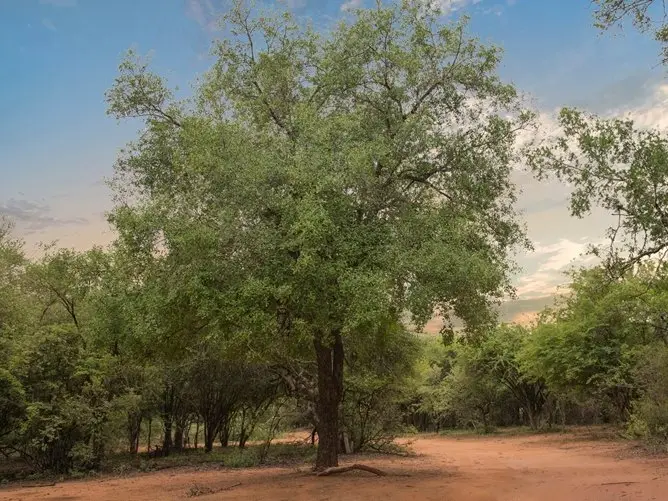
Photo: Willem Frost · CC BY-SA 4.0 · source ↗
Tamboti
Tambotie · Spirostachys africana
Tamboti is the beautiful but dangerous one, with fragrant hardwood and a poisonous milky latex. It often forms distinctive dark thickets on heavy soils.
Log your Tamboti sighting — free →How to identify it
Dark brown to black bark cracked into neat rectangular blocks, like crocodile skin, on a fairly straight trunk. Often grows in dense single-species groves; the leaves turn bright red before falling. Break nothing: the milky sap is caustic.
Flowers & fruit
Small yellowish catkin-like flower spikes in spring (roughly August–October) with the fresh leaves; three-lobed capsules ripen and pop over summer.
Browsed by
Black rhino eat the young branches and porcupine gnaw the bark (both tolerate the toxins); kudu and giraffe browse it to a lesser extent.
Where to see it in Kruger
Common on heavier clay and brackish soils, alluvial flats and along drainage lines through the central and southern park, frequently in dense pure groves.
Did you know
Never braai over tamboti wood: the smoke taints the meat and can cause nausea, and its capsules host a moth larva that makes fallen seed segments jump across the ground in the heat.
See it? Log it — free.
MyKrugerHoliday is a free, offline field guide and one-tap sighting log for a Kruger self-drive. No ads, no account, works with no signal.